
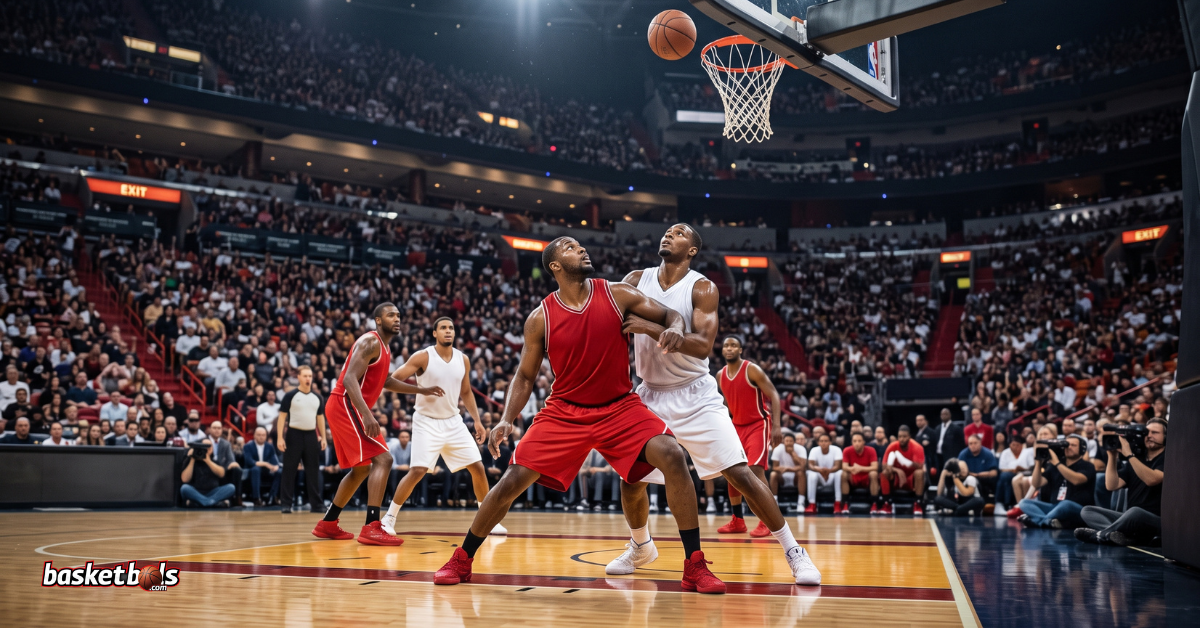
Before Anyone Grabs the Rebound, There Is a Battle for Position. Here Is How Boxing Out Gives Players an Edge Under the Basket
Boxing Out and Securing Rebounds
In a game of basketball, three-point shots, blocks, and dunks are the most prominent actions and the ones generally considered to have the greatest influence on a team’s performance. However, in a real match, there are many unnoticed actions which can still make a difference in determining who controls possession.
So, what is boxing out in basketball? The short answer is that it is the use of one’s body to get between the opponent and the basket when the ball is shot. The goal is to deny the adversary access to the ball and to improve the chances of getting the rebound.
Once the ball leaves the shooter’s hands, the defender must identify the opponent, make legal contact, and get between that player and the basket.
When the ball hits the rim, the second part begins: to keep balance, locate the ball’s trajectory, and make the transition from protecting position to actively pursuing the rebound.
This is often a mistake among beginners, who focus so much on blocking the opponent that they forget about the ball. Those who have played for some time know when to keep the contact and when to separate, to jump, take the ball, and secure possession.
It is necessary to understand that a rebound does not depend only on height. Anticipation, foot position, balance, and reading the ball’s trajectory enable a shorter player to compete for rebounds against a physically superior opponent.
The Basic Idea Behind a Box Out
Anyone who has played or watched a game knows how important securing rebounds in basketball is; for example, offensive rebounds can help in keeping possession of the ball, in determining the tempo of the game, and in getting a second chance on a play that did not go in.
On defense, they cut off the rival’s advance and momentum, and allow the team to regroup. Though one’s size and height matter, it is often more a question of position than of physical gifts, and here the boxing out position is important.
Stay Between Your Opponent and the Ball
A good basketball boxing out technique begins by establishing a favorable position against the opponent.
One can, for example, when a player takes a shot, locate the adversary, make legal contact, and use the body to keep that player away from the area where the ball is likely to come.
To do this, it is necessary to keep one’s knees slightly bent, one’s feet apart, and the centre of gravity low, to keep one’s ground and make it more difficult for the opposing player to move them. In this respect, one must avoid any unlawful contact, such as pushing or extending the arm too far.
Timing Your Move for the Rebound
The art of knowing when to chase the ball and when to maintain the right distance from one’s opponent to allow it to bounce off is essential for the play to work.
The player must keep the block on the adversary long enough to prevent them from moving, but must be ready to act when the ball nears them.
A delay that lasts too long, and another player could grab the rebound. A response that comes too early, and the rival can get back into a favorable position.
At the right moment, they should break away from the contact, rush towards the ball, and if possible, seize it with both hands and bring it under control, especially to control defensive rebounding position.
Position Comes Before the Jump
The best rebounders are not the players who jump the highest. Often the struggle for the rebound begins before the ball touches the rim.
Skilled players anticipate the shot, recognize the possible trajectories of the ball, and try creating space for a rebound catch.
Some relatively short players have succeeded in winning rebounds against much taller opponents, owing to their ability to anticipate movement, their power of occupying space, and their sense of the right time for jumping.
But we must also remember that a good boxing-out doesn’t always end with the same player snatching the ball. In some cases, its task is to keep the opposing rebounder busy so that another player can take possession.
Boxing Out Against Three-Point Shots
Modern basketball has changed the significance of rebounding. More three-pointers can end up far from the basket and make teams cover much more ground.
That means that rebounding no longer depends only on the tallest players. Every player at every position in the game, guards included, must also be able to anticipate the trajectory of the shots, block their opponent, and react quickly to recover the ball.
The same applies to the five members of a team.
How to Evaluate Boxing Out
To understand its effect in the game, it is necessary to look at something more than the total number of rebounds.
| Metric | What It Tells You |
| Defensive Rebound Percentage (DREB%) | What percentage of the available defensive rebounds a team secures |
| Offensive Rebound Percentage (OREB%) | How effective a team is at recovering its own missed shots |
| Second-Chance Points | How many points a team scores after recovering offensive rebounds |
| Box Outs | How many times a player effectively keeps an opponent from getting a rebound |
| Contested Rebounds | How many rebounds a player secures with an opponent nearby |
To evaluate a contest, let’s consider a team that struggles to secure defensive rebounding position, facing another that is especially good at offensive rebounding.
This disparity could give the latter team extra possessions, and that matters in terms of the game’s speed and scoring opportunities. You can also compare these figures with NBA odds at BetUS to understand how the teams are coming in.
Let us bear in mind that more rebounds do not ensure victory. Shooting accuracy, turnovers, pace, and the available lineups also count, but it is good to know what does box out mean in basketball to improve your reading of a game.
FAQs
Why is boxing out important in basketball?
Boxing out keeps an opponent away from the ball, which increases the odds that the player, or their teammate, will secure a rebound. On the defensive side, it ends the rival’s possession and prevents second-chance points, and on offense, it allows a team to keep the ball alive.
How do I box out in basketball?
As the shot goes up, find your opponent, make legal contact with them, and get your body between them and the basket; keep your knees bent, feet apart, and center of gravity low, and do not try to push them away. Once the ball comes off the rim, release the contact, go to the ball, and grab it with both hands.
Do all basketball players need to box out?
Yes. Boxing out isn’t a job reserved for the tallest players, since guards and wings also have to take on opponents, especially with rebounds from three-pointers landing farther from the basket. It works best when all five players on the floor do it.