
What is the 24-Second Shot Clock Rule in Basketball?
If you ever watch an old black-and-white video of a basketball game from the 1940s, you’ll notice something strange: players just standing around, holding the ball, waiting for the clock to run out. It was boring. That all changed in 1954 with the introduction of the 24-Second Shot Clock.
Today, the shot clock is the heartbeat of the game. It forces teams to be decisive, aggressive, and creative. But how does it actually work, and when does it reset? Let’s break it down.
The Basics: 24 Seconds to Shoot
The rule is simple: from the moment a team gains possession of the ball, they have exactly 24 seconds to attempt a shot.
For a shot to count and reset the clock:
- The ball must leave the player’s hand before the clock hits zero.
- The ball must touch the rim (the hoop). If it hits only the backboard and the clock expires, it is a violation.
The Penalty: If the clock hits zero before a shot is taken, a Shot Clock Violation is called. The whistle blows, and the ball is handed over to the opposing team.
The “14-Second Reset” Rule
This is a relatively new rule that many casual fans find confusing. In the old days, every time the ball hit the rim and the offensive team got the rebound, the clock reset to 24 seconds.
To speed up the game even more, the NBA and FIBA changed this. Now, if the offensive team grabs an offensive rebound, the shot clock only resets to 14 seconds. This keeps the pressure on the offense and prevents teams from “milking” the clock.
Why 24 Seconds? (A Bit of History)
Why not 30? Why not 20? The number was calculated by Danny Biasone, the owner of the Syracuse Nationals.
He looked at games that he found exciting and realized that teams took about 120 shots per game. He divided the 48 minutes of a game (2,880 seconds) by 120 shots, and the result was exactly 24. It was a mathematical formula for excitement!
Strategy: “Beating the Clock”
The shot clock creates its own drama. You’ll often hear fans counting down “3… 2… 1…” as a player like Luka Doncic or Kevin Durant is forced to take a “contested” fadeaway shot because time is running out.
Teams also use the shot clock defensively. A “shot clock win” is when a defense plays such good pressure that the offense can’t even get a shot off before the 24 seconds are up.
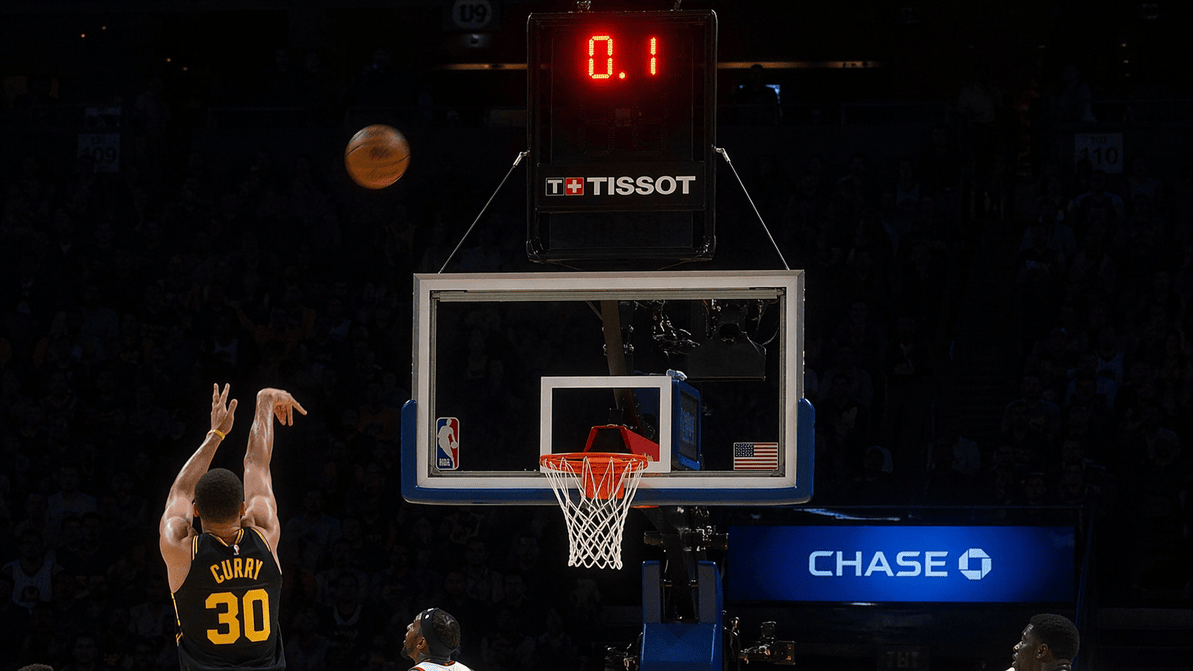
See it in Action: Incredible Shot Clock Buzzer Beaters
🏀 Expand Your Basketball Knowledge
The shot clock is all about speed, but sometimes the game stops for a dangerous play.
Read Next: What is a Flagrant Foul in Basketball? (Learn why some fouls result in more than just a regular whistle).