
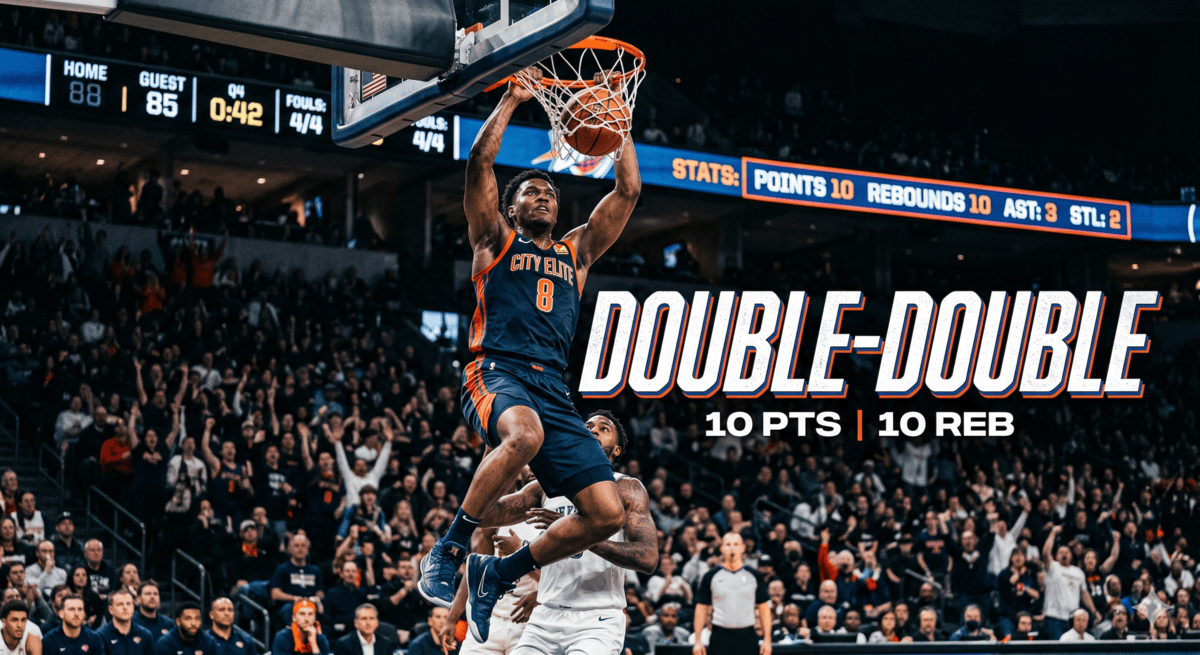
If you have ever watched an NBA broadcast or checked a box score, you have likely heard the term “Double-Double.” While it sounds like a fast-food order, it is actually one of the most important benchmarks of a player’s productivity.
In this guide, we will break down exactly what it means, the different ways to achieve it, and who the masters of the double-double are.
The Definition: What Does It Mean?
A double-double occurs when a player accumulates a double-digit total (10 or more) in two of the five main statistical categories during a single game.
The five statistical categories are:
- Points
- Rebounds
- Assists
- Steals
- Blocks
The Rule: You must hit at least 10 in two different categories. For example, 10 points and 10 rebounds is a double-double. 9 points and 20 rebounds is not.
Most Common Types of Double-Doubles
Not all double-doubles look the same. Depending on the player’s position, they usually achieve it in one of these two ways:
1. Points + Rebounds (The Big Man Special)
This is the most common type, usually achieved by Centers and Power Forwards like Nikola Jokić or Anthony Davis.
- Example: 22 Points, 12 Rebounds.
2. Points + Assists (The Playmaker Special)
This is usually achieved by Point Guards who score and set up their teammates, like Stephen Curry or Tyrese Haliburton.
- Example: 18 Points, 11 Assists.
See it in Action: NBA’s Best Highlights
Double-Double vs. Triple-Double
It is easy to get confused with other “multi-double” stats. Here is a quick comparison table:
| Term | Requirement | Frequency |
| Double-Double | 10+ in 2 categories | Very Common |
| Triple-Double | 10+ in 3 categories | Rare / Elite |
| Quadruple-Double | 10+ in 4 categories | Legendary (Only 4 times in history |
Why Is It Important for Players?
Achieving a double-double shows that a player is doing more than just one job. It proves versatility. A player who scores 30 points but gets 0 rebounds or assists is just a scorer. A player with a double-double is an all-around contributor who helps the team in multiple ways.