
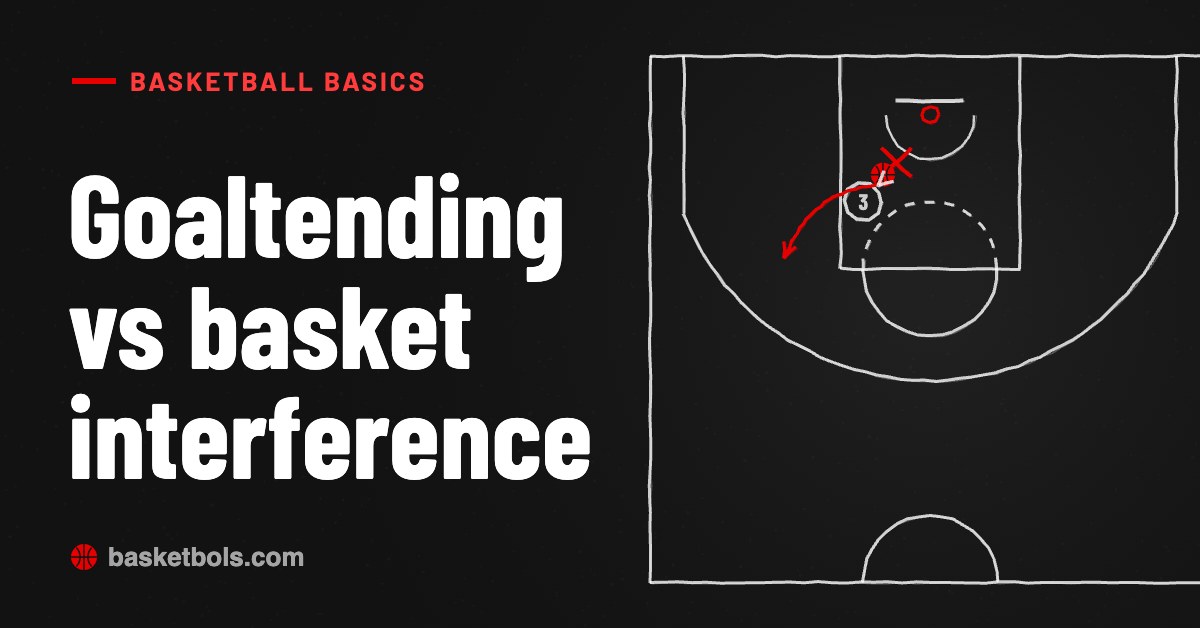
Goaltending and basket interference are two violations that stop a player from touching a shot that still has a chance to score. Goaltending is touching the ball on its way down to the rim or while it is above the rim, and basket interference is touching the rim, the net or the ball while it sits on the rim. In the NBA both fall under one rule and share the same penalty: a defender who commits the violation gives the shooting team the points, and an offensive player who commits it wipes the basket out.
Goaltending means touching a shot that is on its way down or is above the rim inside the imaginary cylinder over it. Basket interference means touching the rim, the net or the ball while it rests on the rim. If a defender does it, the shot counts as made (2 or 3 points). If the offense does it, the basket does not count and the other team gets the ball.
What goaltending is
The NBA rulebook (Rule 11) lists the actions that are not allowed once a shot is in the air and could still score. The ones fans call goaltending are these:
- Touching the ball on its way down. Once a ball with a chance to score starts its downward flight toward the basket, nobody may touch it.
- Touching the ball above the rim. A player on the court may not touch a ball that is above the ring and inside the imaginary cylinder, which is a straight column rising from the rim.
- Touching the ball after it hits the backboard. If the ball touches the backboard above rim level and can still score, it is off limits whether it is going up or coming down. Below rim level, it is off limits only while it is rising.
- Trapping the ball on the backboard. Pinning the ball against the glass after the shot is released is a violation. The hand, the ball and the backboard all have to be in contact at the same moment, so a simple swat that bounces off the glass is not a trapped ball.
The idea is simple: once a shot is on its way down, nobody else gets to change its path.
What basket interference is
Basket interference is about the hardware, not the flight of the ball. The rulebook bans these actions:
- Touching the ball or the ring while the ball sits or rolls on the rim.
- Hanging on the rim while the ball passes through the basket.
- Touching the ball with a hand that is through the ring.
- Shaking the rim, the net or the backboard so the ball bounces in an unnatural way.
- Touching the rim, the net or the ball while the ball is in the net and keeping it from falling through.
There is one exception. A player near his own basket who already has a legal hand on the ball is not called for a violation if that contact carries on after the ball enters the cylinder.
Goaltending vs basket interference at a glance
The terms get mixed up, and the NBA rulebook puts both in one rule. To tell them apart, ask what was touched and where the ball was.
| Goaltending | Basket interference | |
|---|---|---|
| What is touched | The ball | The rim, the net, the backboard or the ball |
| Where the ball is | Falling toward the rim, above the rim in the cylinder, or after it hit the backboard above rim level | On the rim, in the net or passing through the ring |
| Typical example | A defender swats a shot that is already dropping toward the basket | A player grabs the rim or taps a ball that is resting on the rim |
| NBA rulebook | Rule 11 | Rule 11 |
What happens after the call
The penalty depends on which basket the violation happened at, not on a different rule for each action. Under Rule 11, a violation at the opponent’s basket gives the offended team two points, or three if the shot came from the three-point zone. A violation at a team’s own basket means no points are scored.
| Who commits it | Result |
|---|---|
| A defender (violation at the opponent’s basket) | The shooting team gets 2 points, or 3 from the three-point zone, as if the shot had gone in. The other team inbounds from the baseline. |
| An offensive player (violation at its own basket) | No points. The defending team inbounds from the sideline at the free throw line extended. |
| Both teams violate | No points. Play restarts with a jump ball at the center circle. |
Goaltending vs a legal block
A clean block and goaltending look similar on video, but the timing separates them. A defender may swat a shot while it is still rising, as long as it has not reached the space above the rim or touched the backboard above rim level. Once the ball starts to fall, the same swat is a violation. Our guide to the blocked shot shows what a legal block looks like.
The same timing matters on offense. A tip-in is legal when the ball has bounced off the rim and is on its way out, which makes it an ordinary rebound fight. It becomes offensive goaltending if the ball is still above the rim or sitting on it when the hand arrives.
Two quick scenes
Two made-up plays show how the calls work:
- A guard lofts a floater and a big man slaps it while it is falling toward the hoop. Defensive goaltending: the floater counts, 2 points.
- A teammate jumps and taps a missed three while it is hovering over the rim. Offensive violation: the three does not count and the defense gets the ball.
How FIBA handles it
International basketball keeps the same core idea. FIBA Article 31 treats a ball that is completely above the level of the ring, on its way down or after touching the backboard, as off limits, and it says that interference by a defender is rewarded with 1, 2 or 3 points depending on the shot. Offensive violations bring no points and a throw-in for the opponents from the free throw line extended. The details differ from the NBA, though: FIBA only protects a ball that is completely above the ring, it has no imaginary cylinder, and it adds its own free throw rules. For the size of the hoop and the court these rules play out on, see the court dimensions guide.
Keep learning
- What is a double dribble in basketball? The rule explained
- What is traveling in basketball? The rule and the gather step explained
- What is the 8-second backcourt rule in basketball?
FAQ
Is goaltending the same as basket interference?
Not in everyday use, but the NBA rulebook handles them together in Rule 11 with one set of penalties. Goaltending usually means touching the ball on its way down or above the rim. Basket interference usually means touching the rim, the net or a ball that is resting on the rim.
Does a goaltending call count as a made basket?
When a defender is called, yes. The shooting team is awarded two points, or three if the shot was from the three-point zone. When an offensive player is called, the basket does not count and the other team gets the ball.
Can a player touch the ball after it hits the rim?
In the NBA, yes, once the ball is no longer sitting on the rim or inside the cylinder above it. Players then fight for the rebound normally. The exception is a ball that touched the backboard above rim level and can still score, which nobody may touch.
Sources
- NBA Official: Rule No. 11, Basket Interference and Goaltending
- NBA Official: 2025-26 NBA Playing Rules (Rules 6 and 11)
- FIBA: Official Basketball Rules 2026 (Article 31)
- Jr. NBA: Goaltending