
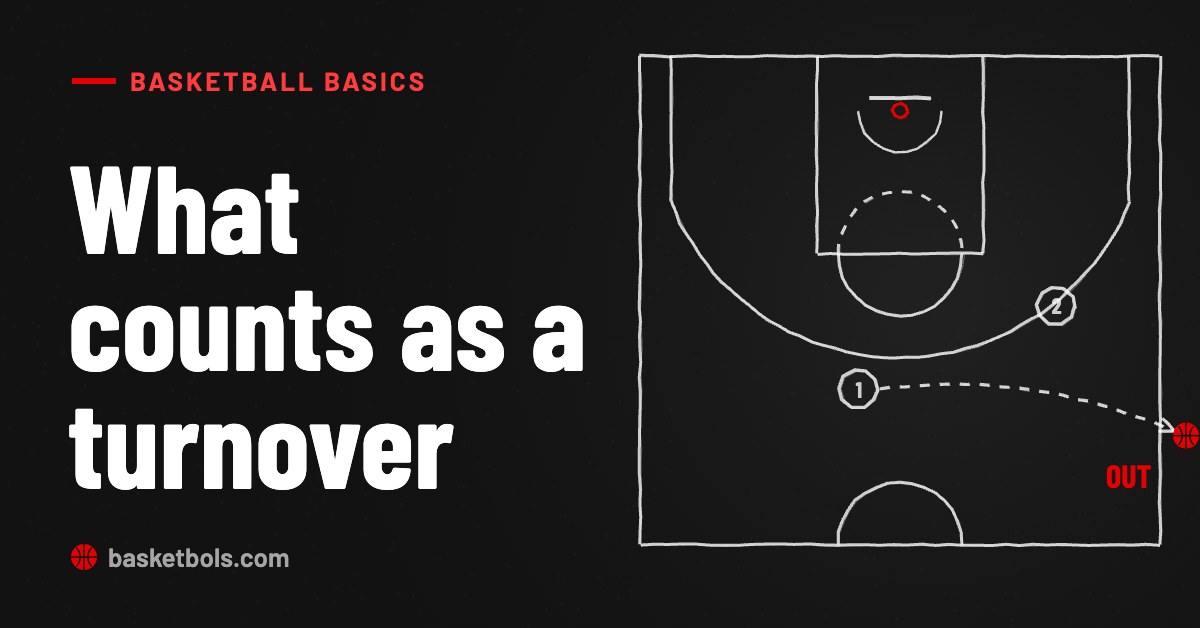
In basketball, the goal of every offensive possession is to get a high-quality shot. When a team loses the ball before a shot is even taken, it is called a Turnover.
For coaches, turnovers are a nightmare. For the defense, they are a victory. In this guide, we’ll break down exactly what counts as a turnover and look at why even the greatest players in history sometimes struggle to keep the ball secure.
A turnover is any time the offense loses the ball to the other team before getting a shot off, through a steal, a violation like traveling or an offensive foul. LeBron James has the most career turnovers in NBA history.
The Definition: What Counts as a Turnover?
A turnover occurs when the offensive team loses possession of the ball to the defensive team before a player takes a shot.
There are two main categories of turnovers:
Live-Ball Turnovers
This happens when the defense steals the ball while it is in play. For example, a “pick-pocket” steal or an intercepted pass. These are the most dangerous because they often lead to easy fast-break points for the opponent.
Dead-Ball Turnovers (Violations)
These occur when the referee blows the whistle due to an illegal action. Common examples include:
- Traveling: Taking too many steps.
- Double Dribble: Dribbling, stopping, and starting again.
- Out of Bounds: Stepping on the line or throwing the ball outside the court.
- Offensive Fouls: Charging into a defender.
The “Irony” of Turnovers: Why Stars Have More
If you look at the NBA leaderboards, you might be surprised to see that legendary players like LeBron James or Russell Westbrook have incredibly high turnover numbers.
Why? Because the more you have the ball, the more likely you are to lose it. High-usage players who create plays for others naturally take more risks. In the NBA, LeBron James actually holds the record for the most career turnovers, but that is simply because he has played at an elite level for over 20 years.
Forced vs. Unforced Turnovers
- Forced Turnover: The defense played great pressure, tipped a pass, or “trapped” the ball handler.
- Unforced Turnover: The offensive player made a mistake on their own, like a bad pass to nobody or stepping out of bounds without pressure. Coaches hate these the most!
See it in Action: The Most Bizarre Turnovers
Turnovers in the box score
Turnovers are listed as TO or TOV. NBA teams usually commit somewhere around 12 to 16 per game, and every one of them is a possession that ends without a shot.
Some turnovers are charged to the team instead of a player, like a shot clock violation, where no single player is at fault. They still count in the team total.
How teams cut down turnovers
- Make the simple pass: the safe pass that keeps the possession alive beats the risky one that could lead to a highlight.
- Jump stops and pivots: they help a driver avoid traveling calls in traffic.
- Strong passes: two-handed chest and bounce passes are harder to intercept than soft lobs over the defense.
- Spacing: when players spread the floor, the defense cannot crowd the ball handler.
Live-ball turnovers hurt the most, because the defense is already running the other way. A turnover that goes out of bounds at least lets the defense get set.
Analysts also use turnover percentage, an estimate of turnovers per 100 plays. It makes it fairer to compare a point guard who has the ball all game with a big man who rarely handles it.
Keep learning
- What is a steal in basketball?
- The 8-second backcourt rule explained
- What is the 3-second rule in basketball?
FAQ
Is a shot clock violation a turnover?
Yes. Shot clock, 8-second and 3-second violations all count as turnovers.
Is an offensive foul a turnover?
Yes. A charge or any other offensive foul gives the ball to the defense and is recorded as a turnover.
Who has the most turnovers in NBA history?
LeBron James with 5,651, ahead of Russell Westbrook (5,038) and Karl Malone (4,524), according to Basketball-Reference as of October 2026. Turnovers were first tracked in the 1977-78 season.
Sources
- Basketball-Reference: Career Leaders for Turnovers
- NBA Official Rulebook: Rule No. 10, Violations and Penalties