
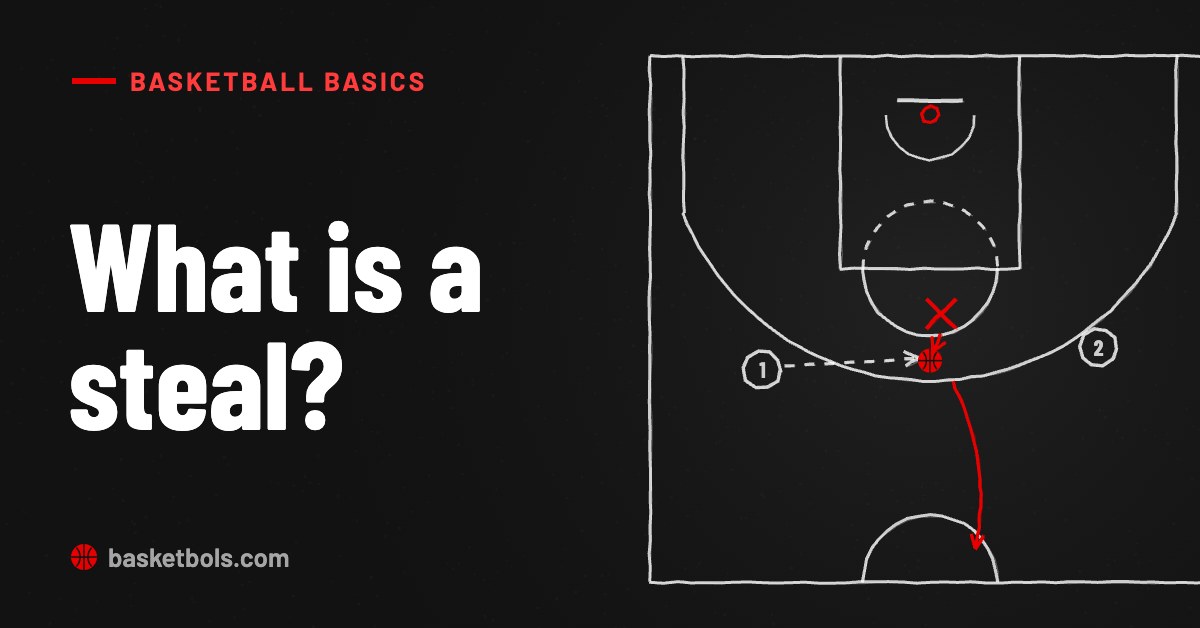
In basketball, the best offense is often a great defense. One of the most effective ways to demoralize an opponent is the Steal. It turns a defensive possession into an immediate scoring opportunity and is the ultimate display of a player’s “defensive IQ.”
But what exactly counts as a steal, and how do you get one without picking up a foul? In this guide, we’ll break down the rules and look at the “pick-pockets” who mastered the art of the steal.
A steal is credited to the defender whose action, like stripping the dribbler or intercepting a pass, causes a turnover. John Stockton holds the NBA career record with 3,265 steals.
The Definition: What Counts as a Steal?
A steal is credited to a defensive player who legally gains possession of the ball from an opponent through their own positive action.
Common ways to record a steal:
- Picking the Pocket: Stripping the ball away from an opponent while they are dribbling.
- Intercepting a Pass: Catching a pass intended for another offensive player.
- Deflecting the Ball: Poking the ball away and then recovering it (or a teammate recovering it).
The Rule: You only get credit for a steal if your action directly causes the turnover. If the offensive team simply throws the ball out of bounds, no steal is awarded.
Steals vs. Fouls: The “Reach-In” Risk
The hardest part about getting a steal is avoiding the Reach-In Foul. To get a clean steal, the defender must make contact with the ball, not the player’s hands, arms, or body. If you “hack” the dribbler while trying to steal the ball, the referee will blow the whistle.
The Legends of the Steal
To be a great “thief” on the court, you need incredible anticipation and hand speed. Here are the all-time NBA leaders:
- John Stockton: Just like with assists, Stockton is the undisputed king of steals with 3,265 career steals. His ability to read the opponent’s mind made him a defensive nightmare.
- Jason Kidd: A versatile guard who used his size and speed to rack up 2,684 steals.
- Chris Paul: Known as “The Point God,” he has led the NBA in steals multiple times due to his surgical precision.
- Gary Payton: Nicknamed “The Glove,” he won Defensive Player of the Year in 1996, and no other guard won it until Marcus Smart in 2022.
See it in Action: The Art of the Steal
Steals in the box score
Steals are listed as STL. Leading the NBA in steals usually takes around two per game, so even a small increase over a season makes a big difference.
Every steal is also a turnover for the other team, so the two numbers mirror each other. The player who lost the ball gets the turnover, and the defender who caused it gets the steal.
How defenders get steals
- Reading passing lanes: watching the passer’s eyes and jumping a lazy pass.
- Digging on drives: a quick swipe at the ball when a driver brings it close to a help defender.
- Pressure on the dribble: staying low and attacking the ball when the dribbler picks it up high or crosses over in front of you.
The risk is that a missed steal attempt leaves the defender out of position and gives up an easy basket. Coaches want steals without gambling, and players who collect a lot of steals while rarely fouling are the most valuable defenders.
Steals and fast breaks
A steal in the open court often leads straight to a layup or dunk, because the other team is still moving in the wrong direction. That is why teams that force a lot of live-ball turnovers usually score a lot of fast-break points.
Keep learning
- What is a turnover in basketball?
- What is a blocked shot in basketball?
- What is an assist in basketball?
FAQ
Is it a steal if a teammate recovers the ball?
Yes. The steal goes to the defender who caused the turnover, even if a teammate ends up with the ball.
Is reaching in a foul?
Only if there is illegal contact. Touching just the ball is legal, while slapping the ball handler’s arm or body is a personal foul.
Who has the most steals in NBA history?
John Stockton with 3,265, ahead of Chris Paul (2,728) and Jason Kidd (2,684), according to Basketball-Reference as of October 2026. Steals have only been tracked since the 1973-74 season.
Sources
- Basketball-Reference: Career Leaders for Steals
- ESPN: Marcus Smart wins NBA Defensive Player of the Year