
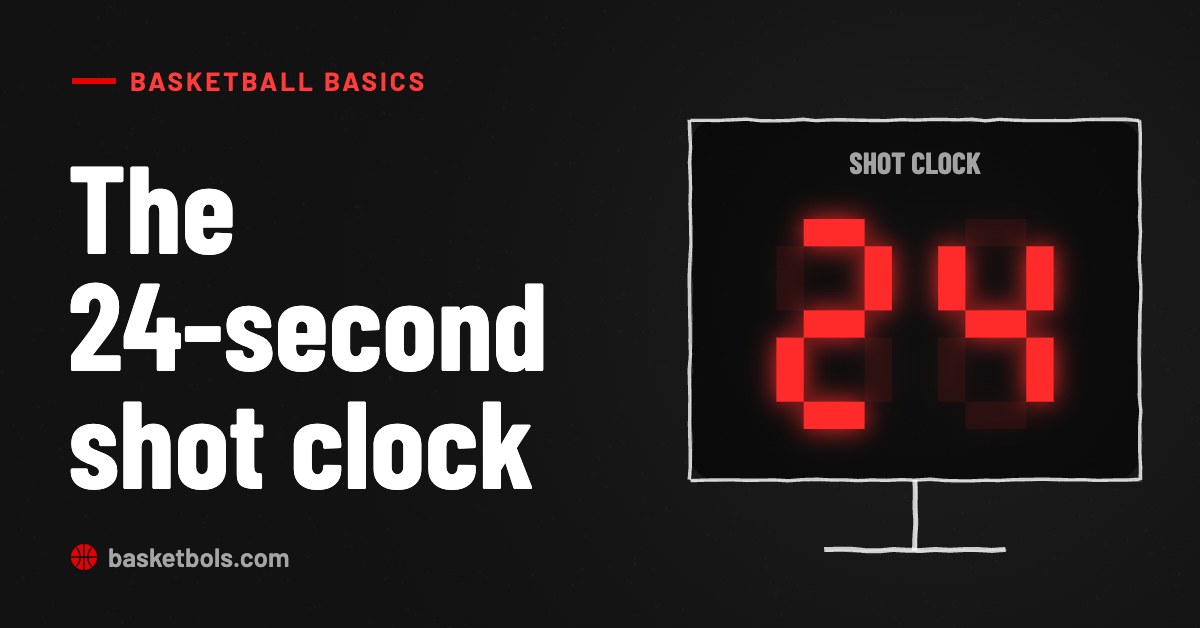
If you ever watch an old black-and-white video of a basketball game from the 1940s, you’ll notice something strange: players just standing around, holding the ball, waiting for the clock to run out. It was boring. That all changed in 1954 with the introduction of the 24-Second Shot Clock.
Today, the shot clock is the heartbeat of the game. It forces teams to be decisive, aggressive, and creative. But how does it actually work, and when does it reset? Let’s break it down.
A team has 24 seconds to get a shot off. The ball must leave the shooter’s hand before the clock hits zero and then touch the rim. After an offensive rebound off the rim, the NBA resets the clock to 14 seconds.
The Basics: 24 Seconds to Shoot
The rule is simple: from the moment a team gains possession of the ball, they have exactly 24 seconds to attempt a shot.
For a shot to count and reset the clock:
- The ball must leave the player’s hand before the clock hits zero.
- The ball must touch the rim (the hoop). If it hits only the backboard and the clock expires, it is a violation.
The Penalty: If the clock hits zero before a shot is taken, a Shot Clock Violation is called. The whistle blows, and the ball is handed over to the opposing team.
The “14-Second Reset” Rule
This is a relatively new rule that many casual fans find confusing. In the old days, every time the ball hit the rim and the offensive team got the rebound, the clock reset to 24 seconds.
To speed up the game even more, the NBA and FIBA changed this. Now, if the offensive team grabs an offensive rebound, the shot clock only resets to 14 seconds. This keeps the pressure on the offense and prevents teams from “milking” the clock.
Why 24 Seconds? (A Bit of History)
Why not 30? Why not 20? The number was calculated by Danny Biasone, the owner of the Syracuse Nationals.
He looked at games that he found exciting and realized that teams took about 120 shots per game. He divided the 48 minutes of a game (2,880 seconds) by 120 shots, and the result was exactly 24. It was a mathematical formula for excitement!
Strategy: “Beating the Clock”
The shot clock creates its own drama. You’ll often hear fans counting down “3… 2… 1…” as a player like Luka Doncic or Kevin Durant is forced to take a “contested” fadeaway shot because time is running out.
Teams also use the shot clock defensively. A “shot clock win” is when a defense plays such good pressure that the offense can’t even get a shot off before the 24 seconds are up.
See it in Action: Incredible Shot Clock Buzzer Beaters
Shot clocks around the game
- NBA: 24 seconds, reset to 14 after an offensive rebound off the rim.
- FIBA: 24 seconds, also reset to 14 after an offensive rebound.
- WNBA: 24 seconds.
- NCAA college basketball: 30 seconds for men and women.
The shot clock is shown above both baskets, so players, coaches and fans can see it from anywhere in the arena.
When the shot clock is turned off
Near the end of a quarter, when the game clock shows less time than the shot clock, the shot clock is switched off. The period will end before it could run out, so the offense can hold the ball for the last shot.
Shot clock and game clock
The game clock shows the time left in the quarter (12 minutes in the NBA, 10 in FIBA), while the shot clock only counts the current possession. They run at the same time but reset separately.
Keep learning
- The 8-second backcourt rule explained
- What is the 3-second rule in basketball?
- How the 3-point line changed basketball
FAQ
What happens on a shot clock violation?
The other team gets the ball with a throw-in from the sideline.
Does the shot clock reset if the ball only hits the backboard?
No. The ball has to touch the rim. An air ball or a shot that only hits the backboard does not reset it.
When did the NBA add the shot clock?
For the 1954-55 season, after Syracuse Nationals owner Danny Biasone pushed for it.